Understanding the Changing Publishing Landscape
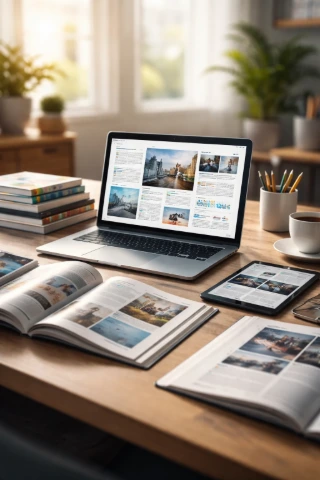
Publishing has undergone significant changes over the past few decades. Early digital publications often attempted to recreate familiar printed pages on a computer screen, while later formats introduced search functions, hyperlinks, multimedia, responsive layouts, and browser-based access. Smartphones and tablets have further changed where, when, and how readers interact with published material.
Our aim is to explain these developments in a clear and accessible way. Rather than treating digital publishing as a replacement for print, we look at how different formats have developed alongside one another. Books, magazines, catalogues, educational resources, and periodicals each have different requirements, and the most suitable format often depends on how readers expect to use the content.
What We Cover
Our coverage extends across digital publications, interactive media, digital learning, and publishing archives. We look at everything from ebooks and digital magazines to multimedia documents that combine written content with video, audio, animation, interactive maps, and other features.
Education is another important part of our coverage. Digital textbooks and online course materials have introduced new ways to search, annotate, organize, and interact with information. At the same time, printed textbooks remain widely used, illustrating how new technologies frequently complement existing publishing methods rather than completely replacing them.
Looking Back as Publishing Moves Forward
Digital publishing also creates new questions about preservation. A printed book can survive for centuries if it is properly stored, while a digital publication may become inaccessible when a website closes, software is discontinued, or a file format becomes obsolete. Preserving digital publishing history can therefore require maintaining not only text and images but also the technology that shaped the original experience.
Digital Publishing & Media Journal documents these changes while making publishing history and technology easier to understand. By looking at both past developments and current practices, we provide context for how reading, learning, and publishing continue to evolve across print and digital environments.